
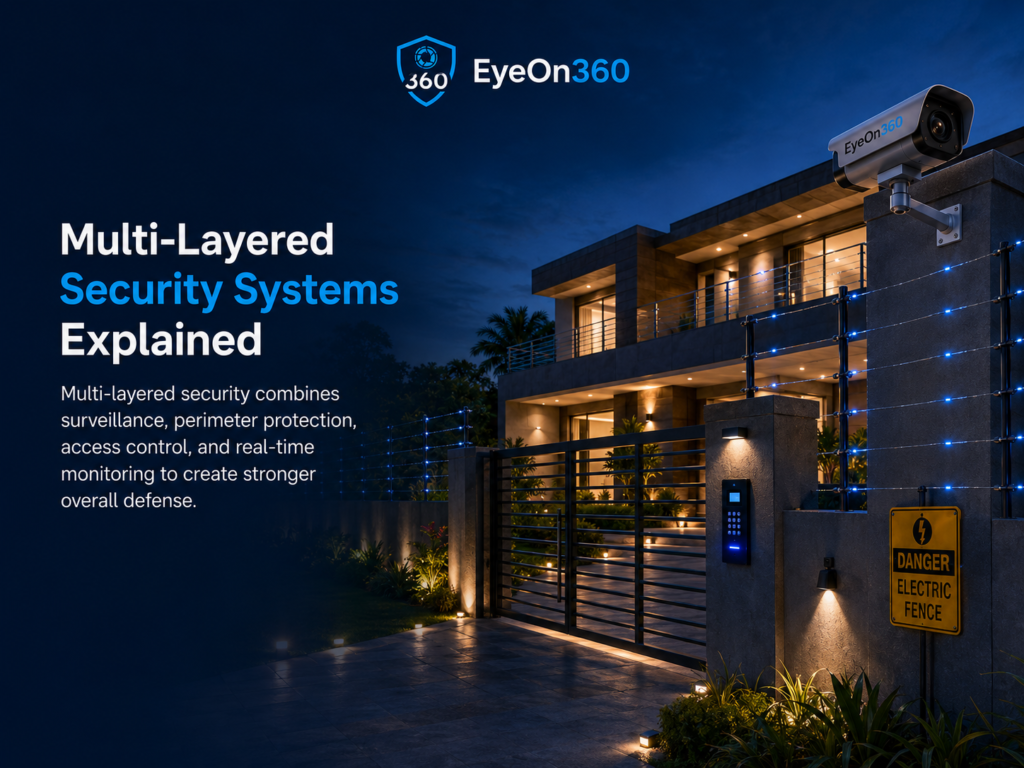
Whereas in a digital world, security is not about just one lock, one firewall or a password. Threats have evolved to be more sophisticated, fast and multidimensional. Organizations are under threat from all angles, ranging from cyberattacks to data breaches, to physical intrusions and insider threats.
There’s where multi-layered security systems come in.
A multi layered security system is an all-rounded security strategy where multiple layers of defending systems, both digital and physical, are used to protect assets, data, people and infrastructure. It does not depend on a single security measure, but rather it creates a series of interrelated security measures.
This article will explore how these systems function, their importance in today’s settings, how industries use them, and what the future of these systems and integrated protection ecosystems, such as the one that Eyeon360 supports, has in store.
Table of Contents
What is Meant by a Multi-Layered Security System?
Security strategy that employs multiple security controls at various levels in an organization’s environment is called a multi-layered security system (also called defense-in-depth).
It combines rather than relying on one barrier:It combines rather than depending on one barrier such as a firewall or CCTV:
- Physical security systems
- Network security systems
- Application security
- Endpoint protection
Data encryption and access control:
- Identity management
- Monitoring and response systems.
- Human security protocols
A layer serves as a redundant backup of the other layers. Each layer provides protection in case of any failure to the other layers, so that no single point of failure can result in the entire system failing.
Multi-Layered Security is Important
Threats in the modern world are not straightforward. It is unusual for attackers to just use one method. Rather, they take advantage of the weak points in systems, people and processes.
Multi-layered security is important for the following reasons:
- Cyber threats evolve quickly.
Worldwide, cybercrime is growing in all its forms, from ransomware to phishing attacks to advanced persistent threats.
- Hybrid Work Environments
Multiple systems on multiple devices available to employees — higher exposure.
- Complex Digital Infrastructure
Cloud systems and APIs, IoT devices and remote servers create attack surfaces.
- Human Error Factor
Many breaches are caused by human error, failure to use strong passwords or a phishing attack.
- Compliance Requirements
Industries should adhere to data protection laws and international data protection standards.
- Physical + Digital Convergence
Security is no longer limited to cyber systems and physical protection of infrastructure.
The Key Components of a Security System
A strong multi-layered security framework is one that relies on multiple layers that are intertwined.
- Physical Security Layer
Physical security is the first and most apparent form of security.
Key components:
- Wireless CCTV systems
- Biometric access control (fingerprint, facial recognition)
- Smart locks and card-based entry systems.
- Security guards/monitoring staff
- Motion detectors and alarm systems
- Protect server rooms / restricted areas
Physical security is the protection of critical facilities such as servers, control rooms, and equipment from unauthorized access.
No matter how sophisticated a cybersecurity system, it is useless if anybody could go in and access the hardware.
- Network Security Layer
Network security safeguards the transference of data between systems, servers and external network connections.
Key components:
- Firewalls
- Intrusion Detection Systems (IDS) are referred to as intrusion detection systems.
- Intrusion Prevention Systems (IPS)
- VPNs (Virtual Private Networks).
- Network segmentation
- Secure gateways
This layer serves as a digital barrier, filtering out malicious traffic and thwarting unauthorized access attempts.
For instance, if suspicious activity is happening, an IDS starts to alert and an IPS can go ahead and block the threat in real-time.
- Endpoint Security Layer
Endpoints range from laptops to smartphones, tablets to servers.
Key protections:
- Anti-virus and anti-malware programs.
- Endpoint Detection and Response (EDR) systems.
- Device encryption
- Mobile Device Management (MDM)
- Application control policies
All endpoints represent potential attack points. When one device is compromised, it can be used to infect the network.
This is why endpoint protection is so important in the remote/hybrid workplace.
- Application Security Layer
Applications are common targets since they are directly dealing with user input and with sensitive data.
Application security includes:
- Secure coding practices
- Regular penetration testing
- Multi-factor authentication (MFA)
- API security controls
Addressing patch management and updates.Dealing with patch management and updates.
Common vulnerabilities include SQL injection, cross-site scripting (XSS) and insecure APIs.
Application security is when software is developed and updated with security considerations.
- Data Security Layer
Information is among the most valuable possessions of an organization.
Key protections:
- Encryption (both data in rest and data in transit)
- Disasters typically destroy data.Disasters usually destroy data.
- Data classification policies
- Access restrictions
- Tokenization and masking
- Data that’s stolen is still unreadable without the proper keys, even if it does happen.
This layer is particularly crucial for sectors such as healthcare, banking, and other government-related systems.
- Identity and Access Management (IAM)
IAM is a mechanism for managing access to resources in a system.
Core features:
- Multi-Factor Authentication (MFA)
- Role Based Access Control (RBAC)
- Single Sign-On (SSO)
- Privileged access management
- Lifecycles and password policies.
IAM minimizes insider risks and provides restriction on access to data that is relevant to individual employees’ roles.
- Monitoring and Response Layer
Security is more than prevention, it’s also detection and response.
This layer includes:
- Security Information and Event Management (SIEM) systems
- Real-time alerting dashboards
- Threat intelligence platforms
- Incident response teams
- Behavioral analytics
Continuous monitoring enables the identification of abnormal trends such as unauthorized log-in attempts and data leakage.
- Human Security Layer
Human beings are still one of the weakest links in a system.
This layer is about:
- Employee cybersecurity training
- Phishing awareness programs
- Compliance rules and security policies
- Incident reporting systems
- Social engineering defense
Cyber security technology can still be circumvented with a simple email phishing or poor password.
The True Strength of this System is the Integration
Example scenario:
- An attacker tries to breach a system through physical means.Someone tries to hack physically.
- Physical security systems limit access.
- Network security will detect abnormal activity if it is not bypassed
- The compromised device is isolated with endpoint systems
- Any attempt to exploit the application is thwarted by application security.
- Sensitive information is protected by data encryption.
- Monitoring systems raise alarms to security staff.
- Human response teams implement incident protocols.
This gives a defense in depth model as each layer reinforces and augments the others.
Multi-Layered Security Systems have Several Advantages
- Provide effective protection from multiple threats.
Each layer is for a different attack method.
- Lower chances of total system failure.
There are different vulnerabilities in every system and none of them is enough to make the system unsafe.
- Faster Threat Detection
Anomalies are detected at an early stage using a monitoring tool.
- Improved Regulatory Compliance
Complies with industry standards such as ISO, GDPR and cyber security frameworks.
- Business Continuity
Operations are resumed even if attacked or disrupted.
- Scalability and Flexibility
Additional layers can be added as technology advances.
- Better Risk Management
Helps organizations identify and prioritize vulnerabilities.
Real-World Applications
There are many examples of multi-layered security systems in use throughout the industries:
Corporate Enterprises
Maintain security on internal systems, employee information and financial records.
Banking and Finance
Ensure safe transactions, thwart fraud, and safeguard customer identity.
Healthcare Sector
Protect patient information and healthcare systems.
Smart Cities
Operate monitors, traffic and emergency response.
Industrial Infrastructure
Protect operational technology (OT) and critical facilities.
Eyeon360 and other entities specialize in comprehensive monitoring and smart Industrial security systems, complementing multi-level security approaches to boost visibility and response abilities across settings.
The Problems of Multi-Layered Security Systems
Although these systems have some benefits, they also have some drawbacks:
- High Implementation Costs
There are several tools and systems that need to be invested.
- Complex Integration
Not all security systems can function properly with each other.
- Skilled Workforce Requirement
Needs skilled cyber security experts.
- System Overload
Having to deal with too many alerts can lead to “alert fatigue.”
- Maintenance and Upgrades
Continuous updating is essential if it’s to be effective.
Best Practices for Implementation
To build a strong multi-layered security system, organizations should:
- Begin with a Zero Trust Model.
When in doubt, check it out.
- Use End-to-End Encryption
Secure Data throughout the PENTAX Media Platform.
- Carry out routine security audits.
Identify vulnerabilities proactively.
- Train Employees Continuously
People need to be aware.
- Centralize Monitoring Systems
Employ consolidated dashboards for visibility.
- Develop Incident Response Plans
Be prepared for emergencies.
- Keep Systems Updated
Patch vulnerabilities regularly.
The Future of Multi-Layered Security Systems
Security systems are getting updated on a regular basis with new technology.
Key future trends:
- AI-powered threat detection
- Behavioral Analytics using machine learning technology
- Automated incident response
- Cloud-native security frameworks
- Zero Trust Network Access (ZTNA)
- The protection of IoT and smart devices
- Predictive cybersecurity models
Automation, intelligence, and real-time adaptation will be the key areas of the future.
Conclusion
Multi-level security systems are the future of modern security strategies. With threats getting more sophisticated and volatile, a single security solution is no longer enough.
Mixed with physical, digital and human security layers, the organizations can create resilient systems that can detect, prevent and respond to threats more effectively.
Eyeon360 is an example of a company that is contributing to this transformation by embedding smart monitoring and sophisticated surveillance capabilities into a wider security landscape. Finally, security isn’t about a single layer, it’s about layers, redundancies and keeping an eye on things all the time.