
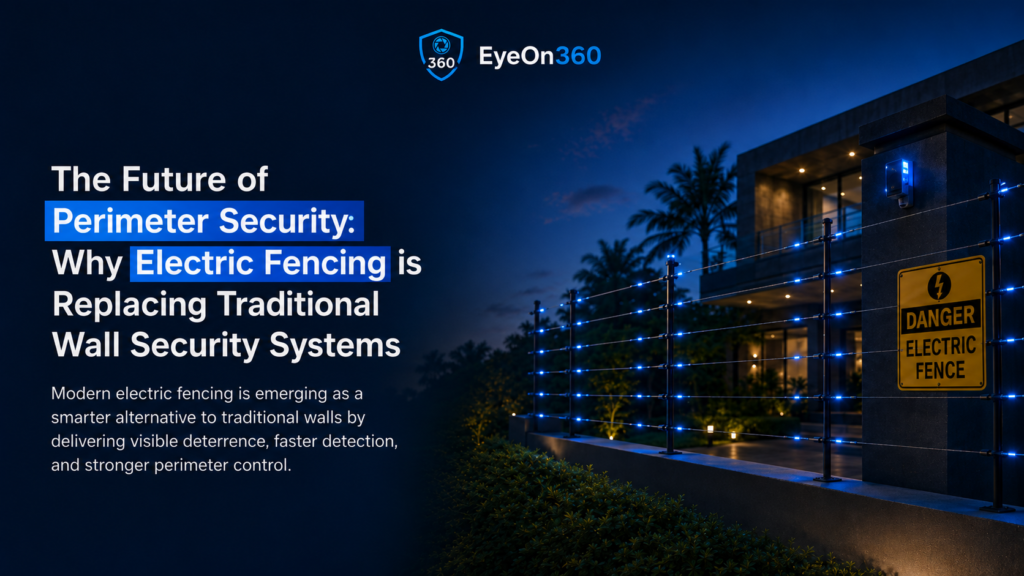
Examine the working of security today, particularly in a fast-growing city like Karachi, and you will find an interesting thing. Home, factory and commercial property owners are increasingly looking at alternative ways of protecting their properties. The traditional solution was to construct a boundary wall, install some barbed wire at the top and perhaps hire someone as a gate guard. That was thought to be sufficient.
However, over time, people have begun to understand that such a practice is no longer as effective as it once was. Security threats are more sophisticated, properties are bigger, and response time is more important than ever. As a result, a new type of perimeter security is gaining popularity: electric fencing.
This isn’t just an alternative to conventional walls, it’s a step-up in the way security is understood.
Table of Contents
Why traditional boundary walls are no longer enough
Even today, a boundary wall is still significant in marking boundaries and for privacy. But in terms of security, it has definite drawbacks.
The primary problem is that walls will not respond to any stimuli. The wall itself does not stop anyone from climbing over it/breaking through it in real time if a person tries to do so. It only has an existence in the form of a physical structure.
This is more pronounced in growing cities such as Karachi, where industrial development is rapidly encroaching on residential areas. Perimeter walls are frequently used in large warehouses, factories and even in modern housing developments, but perimeter walls are not enough to stop determined intrusion attempts.
Delayed response is another difficulty. Security guards and/or CCTV will typically only respond to an attempted action. The time lag can be critical in the fight against theft and unauthorized use.
Here’s where the desire for a more active system becomes apparent.
What electric fencing changes in perimeter security
Electric fencing is more proactive in protecting. It does not only draw a line but also serves as a real security barrier that reacts instantly if someone attempts to cross it.
How it works is that it provides a regulated electric pulse into the fence wires. It is not intended to cause harm, but a strong deterrent effect. When someone touches or attempts to put his or her hands on the fence, he or she experiences a sudden shock, which is enough to make him or her feel that it is not worth continuing.
The most crucial element in this system is not only the physical response, but the psychological response. Most intrusions are not made in long-term planned ways. They occur rapidly, when there is both a chance and little opposition. A boundary that reacts promptly, is now gone.
In most instances, the introduction of electric fencing is sufficient to discourage any attempt, before it starts.
Why it is becoming popular in cities like Karachi
Karachi is a city with a combination of security. Dense residential areas, extensive industrial areas, and commercial spaces, frequently in close proximity. This results in various security problems.
Industrial sites are mainly concerned with securing large perimeters and a small amount of manpower. Having a guard on every corner of a factory or warehouse at all times isn’t always possible. The use of CCTV systems can aid in monitoring, but it still relies on people to react.
The problem is the same, but a bit different for residential property, particularly a large home or farmhouse. It is challenging to monitor continuously long boundary walls and blind spots can easily occur.
One solution to both these problems is to use electric fencing as a continuous perimeter layer. It does not require continual attention by humans, and can operate across the entirety of the boundary simultaneously.
This has been one of the major factors that brings more homeowners to take it into account as part of their security system.
The role of cost and long-term value
One of the common misconceptions about electric fencing is that it will be costly. However, when considering long-term security costs, that’s not the case.
The costs of traditional security can include several recurring costs: guards, patrols, wall repairs, and upgrades of the physical security over the years. These expenses still increase with the expansion of the property or with an increase in security requirements.
Electric fencing is much different. After installation, it is a relatively low maintenance system for the long-term. It saves labor and the need for frequent structural modifications.
More importantly, it is more efficient. The system discourages attempts to be made at the perimeter, rather than reacting after the breach has taken place. This alone can save potential losses that may cost a lot to come back from.
Security is no longer a single-layer system
One of the most significant shifts in security thinking in recent years has been the realization that a single system is no longer deemed sufficient. Just a wall is not sufficient. Just a camera system is not sufficient. Just guards aren’t enough.
The best way nowadays is layered security.
This is an idea to which electric fencing fits well. It is not intended to be a substitute for other systems, but rather it is designed to be used in conjunction with them. It, when used in conjunction with CCTV cameras, motion sensors, alarm systems and smart locks, constitute a much stronger overall structure.
For instance, if someone tries to disturb an electric fence, it may cause the cameras in the vicinity to zoom in on them. Meanwhile, alarms can be triggered, and alerts can be sent to monitors teams. This helps to cut reaction time and enhance awareness of one’s surroundings.
Companies like EyeOn360 are working with this approach, where different security technologies are connected into a single system instead of working separately.
Changing mindset among homeowners
Perhaps surprisingly, electric fencing is not just for high-security or industrial settings. Some people are also beginning to use it in their homes, particularly in suburban developments with bigger homes.
Usually, they’re farm houses or individual houses. The property may be long and hard to monitor on a continuous basis. In these instances, electric fencing is an easy solution which does not need close monitoring.
But there is a change in attitude as well. Security is no longer viewed as responding to a problem. Now, however, people are looking for prevention as the primary goal, rather than detection.
Where perimeter security is heading next
Based on the trends from the present time, it is evident that perimeter security is heading the way of smarter and connected systems. One of those phases is electric fencing, but it isn’t the last.
These systems are expected to be even more intelligent in the future, with enhanced monitoring capabilities, remote control systems and perhaps AI-driven detection systems that can detect unusual activity before it even happens.
In rapidly expanding cities, like Karachi, this type of development is becoming essential. The greater the infrastructure, the more reliable and responsive security systems are needed.
Final thoughts
While traditional boundary walls remain important in property security, they are not sufficient in and of themselves. Electric fencing has become an effective and practical means to add to the perimeter protection, particularly in high-risk areas where quick response is essential.
It is not a total replacement of existing systems, but it’s a different perspective on how security is done. It uses an active layer as opposed to a passive structure.
With the changing nature of security threats, electric fencing solutions is now losing its spirit of becoming a security upgrade and becoming more and more of a regular security solution, particularly in urban areas such as Karachi where the need for security at homes and offices is rising by the year.