
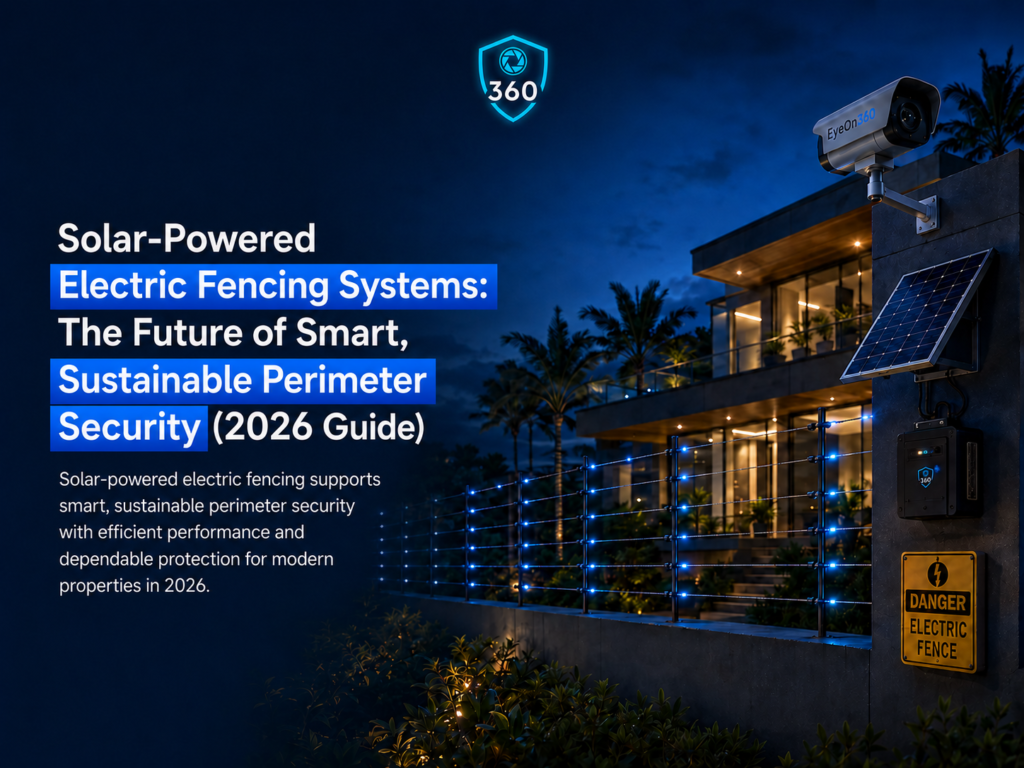
In 2026, security is not just about constructing barriers, it’s about creating barriers. Intelligent, energy-efficient and self-sustaining security is the modern approach. A prime example of this transformation is the electric solar powered fencing system, which combines solar energy with high voltage deterrence to provide effective and affordable protection for land, infrastructure and property.
Solar Electric Fencing is fast taking the place of any traditional fencing systems, due to its ability to overcome three significant issues in agriculture, industry and even residential development; being highly dependent on electricity, increasing security expenses, and the lack of ability to cover remote areas. This system is no longer just a mod to an existing system, it is an essential in parts of the world where electrical power from the grid is not always available and in large rural areas.
Companies such as Eyeon360 are now more interested in incorporating such renewable security solutions into the current perimeter protection system, merging sustainability with security performance.
Table of Contents
Articulate Solar-Powered Electric Fencing Systems
A solar-powered electric fence system is a perimeter security system that utilizes solar power to energize a fence system. The energiser passes the controlled electric pulses along the fence wires at particular time intervals. If anything – human or animal – touches the fence, the circuit is complete and the person or creature is given a shock of just a few seconds and easy to manage intensity.
An electric fence is not just a physical barrier as with conventional fencing, it has a psychological aspect of protection also. It is one of the most effective deterrent-based security systems today and will deter repeated attempts, as the memory of a mild shock will make it less likely to be repeated.
The solar feature also means that the system will not require any outside power source to run, making it ideal for use in remote and off-grid locations or large open areas.
Electric fencing is more effective with solar power
What makes solar energy-powered electric fencing a smart system is its integration with solar energy. In the case of conventional electric fence, power failures can cause openings. However, solar power systems store solar energy in batteries, so that they continue to operate throughout the night.
Solar panels continuously convert sunlight into electricity, and store this energy in deep-cycle batteries. This stored energy is then used by the energiser to maintain a constant voltage output.
The solar fence can be very efficient and cost-effective in regions with abundant sunlight, such as in Pakistan, where they can operate efficiently for a long time without needing to purchase expensive gas or electricity. It cuts out the need for recurring electricity bills, and also lowers the reliance on diesel generators or on an unstable electricity grid.
Explain Core Working Principles in Detail
The system is complex on the outside, but very structured and predictable on the inside.
This process starts with the sun’s energy being absorbed by the solar panels and then converted into direct current (DC) electricity. This energy is then stored in a battery storage system to serve as the backbone of the system when the sun is not shining.
The power source is connected to the fence energizer. This device is the nerve center of the system, it regulates voltage, controls the timing of the pulse, and is used for safety purposes because it stops the current flowing in continuously. The energizer emits brief pulses of electricity, rather than continuously.
These pulses are sent along wires with high tension placed around the fence. Upon contact, the circuit closes in the ground system resulting in a controlled shock. The shock does not cause injury; it is intended to discourage immediately.
This system is effective because it uses repetition and reinforcement of the behavior, not causing any physical harm.
The Most Important Things to Make the System Work
The solar electric fencing system relies on several components working together to ensure its performance and reliability.
It is the job of the solar panels to generate energy. They vary in size and capacity, based on the length of the fence, power consumption and geographical location.
The battery system is used for storing energy and providing continuity. Traditional lead-acid batteries are still in common use, but modern systems are frequently lithium-based that have longer service lives and charging speeds.
- The energiser unit is the control centre. It controls the electric pulses, keeps the voltage safe and controls power distribution.
- Fence wires are usually fabricated of galvanized steel or aluminum alloys, which possess high strength, conductivity, corrosion resistance, and other properties.
- Insulators are very small and important parts that stop the electricity from leaking out of fence posts or the ground too soon.
- A grounding system is the last step of the electrical circuit when intrusion occurs, and completes the circuit so that the shock will be effective.
Optional alarm systems can be installed to alert the user when tampering and/or breakage occur, further enhancing security.
A Wide Variety of Real-World Applications in Industry
The use of solar powered Electric Fencing (EPF) no longer just has to be an alternative to agricultural land. It has become widely used because of its versatility and reliability.
It is commonly used in agriculture to repel wild animals and livestock from the crops. Farmers reap increased benefits such as reduced damage to crops and lesser need for manual guarding.
Electric fencing is used in industrial areas to prevent unauthorised entry and theft at warehouses, storage yards and manufacturing areas.
It is employed in residential communities and large estates for perimeter security as an alternative to concrete walls or barbed wire, offering a level of security without the look of the same.
Solar fencing is a completely self-contained security system that requires no external power in remote construction locations where electrical power could not be provided.
Electric fencing is also employed for the purpose of creating safe boundaries in wildlife conservation areas that would help protecting animals and human settlements without causing harm.
Solar farms, substations and other energy infrastructure sites also depend on these systems heavily because they are required to have continuous protection.
Installation Process and Engineering Considerations
The installation of a solar-powered electric fencing system is a complex process that requires careful planning and technical expertise to ensure that the system is installed properly and is effective.
It starts with a site survey to determine the terrain, perimeter length, risk level and environmental conditions. At this stage, the system design and energy requirement is determined.
System design follows which involves determining the amount of fence, the solar panel size, and the battery size and power of the energizer needed to push the fence.
Then fence posts are set in at regular intervals to hold up the fence and keep the wires in place.
High-tensile wires are then carefully strung and tied with the use of insulators, once posts are set. A good tension is essential for all to perform well and for no sagging.
Solar Panel System and Battery Unit are mounted in a safe, high elevation area where they can receive the maximum amount of sunlight.
Lastly, the whole system is tested. Proper operation of voltage levels, grounding efficiency, pulse timing and alarm integration (if fitting) are checked.
Proper installation is crucial to ensure efficiency, and it’s always best to hire professionals for this task.
Several Advantages Make it a Preferred Security Solution
Solar electric fencing is becoming more popular because of one of the major advantages: its cost efficiency. After the installation, it is a system with low maintenance costs, as it is powered by solar energy.
It also offers un-interrupted protection without human intervention. The system is not required to make shifts or breaks, or get tired of watching the video.The system does not need to rotate shifts, take breaks, or monitor fatigue like a security guard.
It has a very high deterrent effect. It can be a very good psychological obstacle as intruders don’t tend to try it again after that initial shock.
This is another great benefit when it comes to environmental sustainability. The system is solar-powered, using renewable energy, which helps minimize carbon emissions and promotes green infrastructure.
Scalability of the system also makes this one a good choice for small residential properties as well as large industrial estates. The remaining fencing and solar can be scaled up or down based on additional requirements, without a re-design of the entire system.
Challenges and Limitations of Real Use
Although solar powered electric fencing has advantages, there are some problems.
The initial setup price may be comparatively greater than the conventional fencing solutions particularly for bigger properties. This is typically balanced by long-term savings, though.
In long periods of cloudy or rainy days, efficiency of the system might be compromised if the battery capacity is not carefully designed.
Performance may be adversely affected by vegetation growth around fence wires, which may necessitate periodic maintenance.
However, due to inadequate grounding or installation, in some cases, the efficiency can be severely diminished, underscoring the need for proper engineering skills.
Maintenance and Long-Term Performance
Solar electric fence systems are fairly easy to maintain if they are to be reliable over the long-term.
Solar panels need to be cleaned on a regular basis to clear dust and debris that are known to hinder efficiency. Check wiring for corrosion, damage or loose connections.
The health of the batteries should be checked on a regular basis, particularly for older battery types. Trim any vegetation at a minimum distance of fence wires to prevent contact with wires.
To confirm that electrical flow is correct, grounding systems should be tested. The system continues to operate at peak efficiency for many years, due to regular inspections.
If properly maintained, such systems can serve for more than a decade.
The Solar Electric Fencing Technology of the Future
It is evident that the perimeter security market is headed in an automated and smart direction. AI-based systems for intrusion detection, systems with mobile apps for control and systems with IoT-based monitoring are expected to be added to solar electric fencing systems.
These are often hybrid systems using Electric fencing Pakistan in conjunction with Wireless CCTV systems, motion sensors and real time alerts. Such integrated systems will enable the property owner to keep an eye on security from a distance and take action at a moment’s notice to deal with threats.
The technology of renewable energy is continually developing, and solar electric fencing will become an accepted method of security in urban as well as rural areas as the technology continues to improve, become more compact, and cost less.
There are companies already doing this, such as Eyeon360, which promote an integrated, intelligent and sustainable security infrastructures based on renewable energy and the use of modern surveillance systems.
Conclusion
Solar powered electric fencing systems are a significant change of perspective with regards to security. They integrate renewable energy, clever engineering, and effective deterrence all into one dependable system that performs well in a variety of industries and settings.
These systems offer incomparable versatility and value, from safeguarding farmland and industrial sites, to protecting residential and wildlife areas. The cost of a new investment might be a bit more than conventional fencing, but the savings in operational expenses, maintenance, and security in 2026 and beyond are significant. With advancements in technology, solar electric fencing will further develop and become more and more vital to the creation of secure and sustainable environments for the future.