
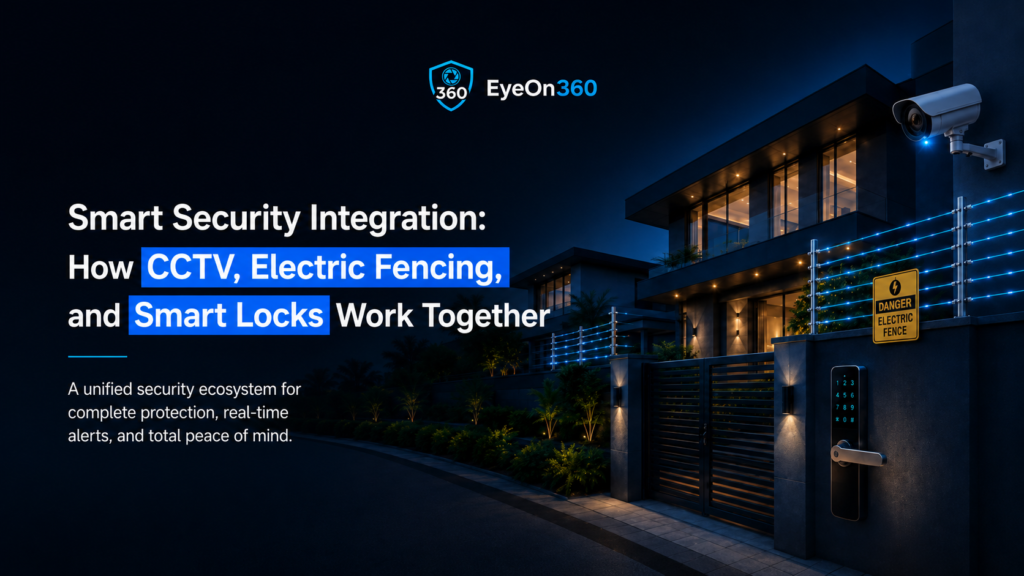
In today’s world, security is not so dependent on a single device. Take a look at the modern houses, warehouses or commercial buildings in cities such as Karachi and you will observe a change that is going on imperceptibly. Property owners should not only use guards or a single CCTV system, but are now using multiple technologies in one system.
This change is known as smart security integration, in which CCTV cameras, electric fencing, and smart locks aren’t used independently but as part of a unified, coordinated system.
Companies like EyeOn360 are increasingly working in this direction, where security is designed as a full ecosystem rather than isolated tools.
Table of Contents
Why single security systems are no longer enough
It is often thought that a few years ago CCTV camera systems or imposing stronger locks was enough. However, a single system alone has its own set of restrictions in real-world situations.
There is, however, a lot of passive technology, such as CCTV which is very useful for recording and monitoring. It reveals the situation, it doesn’t prevent it. Smart locks are used for access control; however, they only lock doors or gates. While electric fencing provides a physical deterrent, it must be backed up with other systems if it is to be truly effective if not monitored.
If these systems are utilized alone, space gaps develop. And when it comes to security, a hole as small as that can turn into a massive problem.
That’s why there’s become such a strong focus on integration.
The idea behind smart security integration
Smart security integration is simply the ability to link up various security systems, which then can talk with each other and take action accordingly.
CCTV, electric fencing and access control is not a separate installation but a single network. This enables the other systems to respond to what they are sensing.
For instance, when a person attempts to climb upon the electric fence or try to disturb the fence, that signal can immediately activate the CCTV cameras which are located nearby the fence and center their focus on the disturbed area. Meanwhile, notifications may be sent to the security team or property owners via mobile.
This level of coordination transforms a passive security environment into an active one.
How CCTV fits into the system
The “eyes” of a security system are typically CCTV. It monitors and records all that is taking place inside and outside the property at all times.
In an integrated system however, CCTV is not simply a recording device. It turns into a reaction method.
Cameras can be automatically zoomed to focus when alerted by electric fencing or smart sensors. Security teams are sent to the exact time and spot in real time, rather than having to view hours of footage.
This decreases response time and accuracy. It also prevents key incidents from going unrecorded when doing large-scale monitoring.
The role of electric fencing in layered protection
Electric fencing provides the initial physical line in a multi-layered approach. It is located on the outside perimeter of the property, and acts as a deterrent and detection system.
One of the primary roles of electric fencing is to deny entry to the inner fence lines of a property before it gets there. The system can detect the activity when it comes into contact with the fence.
This signal is not isolated in an integrated setup. It can be linked to alarms, CCTV cameras and monitoring dashboards. This sets up a cascade effect, triggering several layers of security.
The system reacts at perimeter level, rather than waiting for a breach to occur completely.
Smart locks and controlled access
Smart locks are an additional element in this system. Electric fencing and CCTV control the perimeter and surveillance, smart locks control the controlled entry points.
Digital authentication methods like PIN codes, access cards, biometric scans, or mobile authorization can be used to access these systems. This helps minimize the need for physical keys that easily can be lost or duplicated.
Smart locks can be also connected to other systems in an integrated environment. Attempts to access, for instance, can be logged and matched with CCTV footage. If unusual access behavior is detected, alerts can be generated immediately.
This enhances entry control transparency and traceability.
What makes integration more powerful than individual systems
The power of smart security integration is in the synergy among the technologies, not the technologies themselves.
Layering of security:
- Electric fencing identifies and repels at the border.
- CCTV is used and recorded in real-time.CCTV is used and recorded in real time.
- Smart locks control and verify access points
- They don’t work in isolation, they are a unified system.
This eliminates blind spots, decreases response time and makes it very difficult to detect unauthorized access.
From a practical standpoint, it doesn’t only record a security event, it’s detected, verified, and responded to across multiple levels simultaneously.
Why this approach matters in cities like Karachi
Karachi is a city where security threats can be a combination. High density residential areas, heavy traffic industrial areas with large open spaces and commercial buildings with lots of people and goods moving around.
In these cases, the use of one system may not be sufficient. Activity can be missed by guards and monitoring equipment alone is not sufficient to prevent entry and physical barriers without monitoring are not effective.
Security systems have become more complex, which is why integrated security systems can help to reduce risks. If one layer is passed, other layers are still working and reacting.
That’s why more and more property owners are now moving towards connected systems rather than standalone installations.
The shift toward real-time monitoring
Real-time monitoring is one of the most significant benefits of smart integration. Security teams can respond to incidents as they are occurring, rather than review them after the fact.
Electric fencing, live CCTV and access monitoring details from smart locks are combined in one system. This enables quicker decision-making and shortens the response time gap.
This on-the-spot coordination often is the difference between incidents being contained and escalated.
The future of integrated security systems
In the future, security systems will become even more sophisticatedly integrated. Next, this will likely be followed by AI-driven monitoring and predictive alerts, as well as AI-powered mobile control of security systems.
Systems will be more proactive than just reacting to incidents, and will seek to find suspicious patterns before the incident even happens.
The use of electric fencing, CCTV and smart locks will continue to be used but they will have greater intelligence and connectivity.
Final thoughts
No more having to decide between CCTV, electric fencing or smart locks for your security. It’s about the interconnections of these systems that form a comprehensive protection network.
But taken together, they are worth more than the sum of its parts. When used together they provide a more robust and robust defense, detecting, preventing, and responding to threats simultaneously.
With the increasing security requirements in cities like Karachi, this comprehensive solution is gradually evolving into a requirement for modern properties.
And companies like EyeOn360 are part of this shift, building systems that focus on connection, coordination, and real-time protection rather than isolated solutions.