
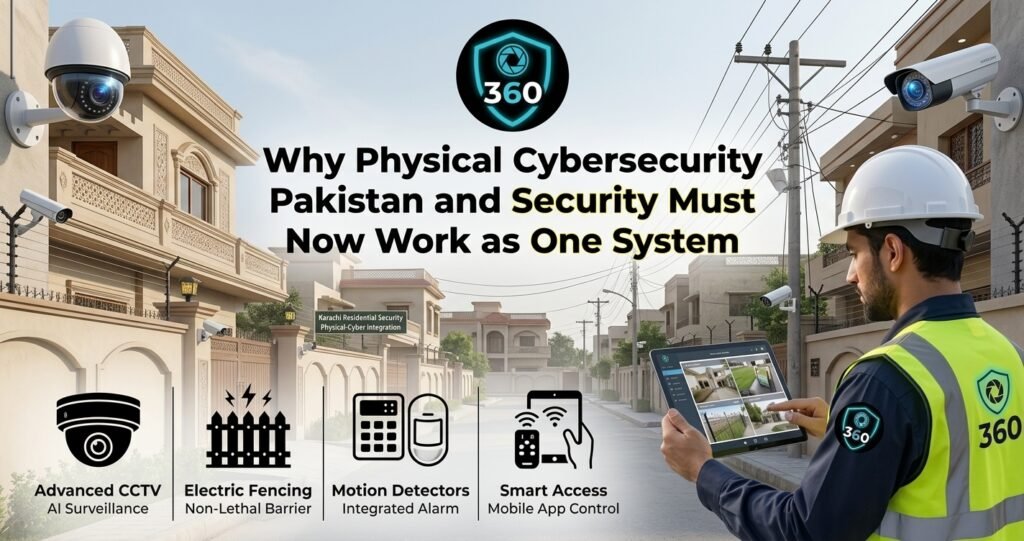
Security is no longer divided neatly between cameras, access control, IT networks, alarms, and security teams. Modern businesses increasingly operate connected environments where a physical event can affect digital systems, while a cyber incident can disrupt physical security infrastructure.
This shift is making physical cybersecurity Pakistan an increasingly important consideration for businesses modernising their security infrastructure.
The trend isn’t simply about buying more security technology. It’s about connecting information from different systems so security teams can understand what is happening across a facility and respond with better context.
Research from the Security Industry Association identifies the convergence of physical security, cybersecurity, and business intelligence as a major direction for the industry. Its 2026 research also highlights AI, connected systems, and integrated security operations as significant developments.
Table of Contents
Why Physical and Digital Security Are Converging
Traditional security systems often operated independently.
Cameras recorded video. Access control recorded entries. Intrusion systems generated alarms. IT teams monitored networks separately.
That separation creates information gaps.
For example, an unusual access event may appear insignificant when viewed alone. However, if the same credential accesses a restricted area while an unusual network login occurs from the same location, the combined information becomes much more useful.
This is where physical security cybersecurity integration becomes important.
Modern integrated security systems Pakistan businesses deploy can bring different security technologies together through shared platforms, APIs, dashboards, and event management tools.
The objective isn’t necessarily to replace every existing system. Modernisation can also involve connecting existing infrastructure with newer software and analytics.
AI Is Changing Security Operations
Artificial intelligence is becoming one of the biggest drivers behind modern physical cybersecurity Pakistan strategies.
The 2026 Genetec State of Physical Security report surveyed more than 7,300 professionals globally and found that interest in adopting AI among end users had more than doubled compared with the previous year. More than 70% of respondents also reported using unified or integrated systems.
AI can help security teams identify unusual activity, classify events, reduce alarm noise, search video, and connect information from multiple sources.
This changes the role of unified security monitoring.
Instead of requiring operators to manually examine every alert, intelligent systems can help prioritise events that deserve human attention.
The Security Industry Association also describes AI-driven triage and behavioural analytics as emerging practical applications in physical security.
Access Control Is Becoming More Intelligent
Access control is another area where physical security cybersecurity is evolving.
Traditional systems generally answer a straightforward question:
Does this credential have permission to enter?
Modern systems can consider additional context.
That can include time, location, identity, authentication method, device information, and unusual behaviour.
The 2026 physical security report identifies mobile credentials, biometrics, multi-factor authentication, physical identity management, and AI-driven alarm reduction among planned access-control capabilities.
This development makes integrated security systems Pakistan businesses particularly relevant for organisations managing multiple offices, warehouses, campuses, commercial buildings, or distributed locations.
A connected platform can give authorised teams a more consistent view of access activity across locations.
The Rise of Unified Security Monitoring
A major problem for security teams isn’t always a lack of information.
It can be too much information.
A business may have hundreds of cameras, multiple access points, alarms, sensors, visitor records, and other data sources. Reviewing each system separately can make it difficult to understand relationships between events.
Unified security monitoring addresses this problem by bringing relevant information into a common operational environment.
For security operations Pakistan businesses, this can make incident investigation more structured.
An operator can potentially move from an access event to associated video, alarm information, and other available system records without switching repeatedly between disconnected platforms.
This is one reason the industry is moving toward integrated security systems Pakistan rather than isolated technologies.
Cybersecurity Must Include Security Devices
There is another side to physical cybersecurity Pakistan that businesses sometimes overlook.
Security equipment itself is now connected technology.
Cameras, access controllers, intercoms, servers, sensors, and management platforms can connect to networks and cloud services.
That creates cybersecurity considerations.
A compromised security device could potentially become an entry point into a wider environment, while an unavailable network could affect security operations.
The Security Industry Association‘s 2026 banking-security discussion specifically highlights the importance of network resilience as organisations adopt cloud-managed video, access control, and analytics.
For security operations Pakistan, this means physical security teams and IT teams increasingly need to understand each other’s environments.
Hybrid Security Infrastructure Is Growing
Businesses don’t necessarily have to choose between completely on-premises and completely cloud-based security.
Hybrid architectures are becoming an important part of modernisation.
The 2026 Genetec research found that 11% of surveyed end users had fully cloud-deployed access control, while 27% operated hybrid systems. The report also identifies cloud, on-premises, and hybrid deployment flexibility as an important direction for security infrastructure.
For integrated security systems Pakistan, this can be useful because businesses may have existing equipment they don’t want to replace immediately.
A phased approach can allow organisations to modernise software, analytics, monitoring, or selected devices while retaining suitable legacy infrastructure.

What Businesses Should Consider Before Modernising
Technology alone doesn’t create effective physical cybersecurity Pakistan.
Businesses should first identify their most important assets, locations, access points, operational risks, and response requirements.
They should then determine which systems need to communicate with one another.
A warehouse may prioritise access control, perimeter monitoring, and vehicle activity.
A corporate office may prioritise identity management, visitor management, and workplace security.
A financial facility may require stronger authentication, network resilience, and detailed event correlation.
This makes unified security monitoring a business design issue rather than simply a technology purchase.
The same principle applies to security operations Pakistan. Teams need clear procedures for who receives alerts, who investigates them, who escalates incidents, and how evidence is retained.
Privacy and Data Governance Matter Too
More connected security systems create more security data.
That data can include video, access records, identities, visitor information, and operational events.
Businesses therefore need appropriate controls around retention, access permissions, data security, and system administration.
The Security Industry Association has published specific guidance addressing privacy considerations in access control and identity-management technology.
This makes privacy an important component of physical security cybersecurity, particularly when organisations introduce biometrics, cloud services, or AI-based analytics.
How Eyeon360 Fits Into Modern Security
Modern security requires more than individual devices working independently. Businesses increasingly need connected visibility across surveillance, access, monitoring, and operational environments.
Eyeon360 can help businesses evaluate and implement security solutions around their operational requirements, supporting the broader move toward connected and intelligent security environments.
For businesses considering integrated security systems Pakistan, the priority should be building an architecture that can grow with changing operational and technology requirements.
The Future of Security Operations
The direction of the industry is becoming clearer.
Physical cybersecurity Pakistan is moving toward connected systems, intelligent analytics, stronger identity controls, and closer cooperation between physical-security and IT teams.
AI will continue influencing unified security monitoring, while cloud and hybrid infrastructure will make distributed security environments easier to manage.
At the same time, physical security cybersecurity will require stronger attention to privacy, network resilience, device security, and responsible technology deployment.
For security operations Pakistan, the important shift is from isolated alerts toward connected information.
And for integrated security systems Pakistan, the long-term objective isn’t simply more technology.
It’s better visibility, stronger coordination, faster understanding of incidents, and security infrastructure that can adapt as the business changes.
FAQs
What is physical cybersecurity Pakistan?
Physical cybersecurity Pakistan refers to protecting physical security infrastructure and connecting it responsibly with cybersecurity practices, including cameras, access control, networks, sensors, and security-management platforms.
Why are integrated security systems Pakistan becoming more important?
Integrated security systems Pakistan can connect previously separate technologies, helping organisations centralise information, improve event correlation, and manage security operations across multiple locations.
How does unified security monitoring help businesses?
Unified security monitoring brings relevant security information into a common operational environment, helping teams identify relationships between access events, alarms, video, and other available data.
Why does physical security cybersecurity require IT involvement?
Physical security cybersecurity increasingly involves network-connected cameras, access controllers, servers, cloud platforms, and other devices. IT involvement can help address network security, access permissions, updates, resilience, and data protection.