
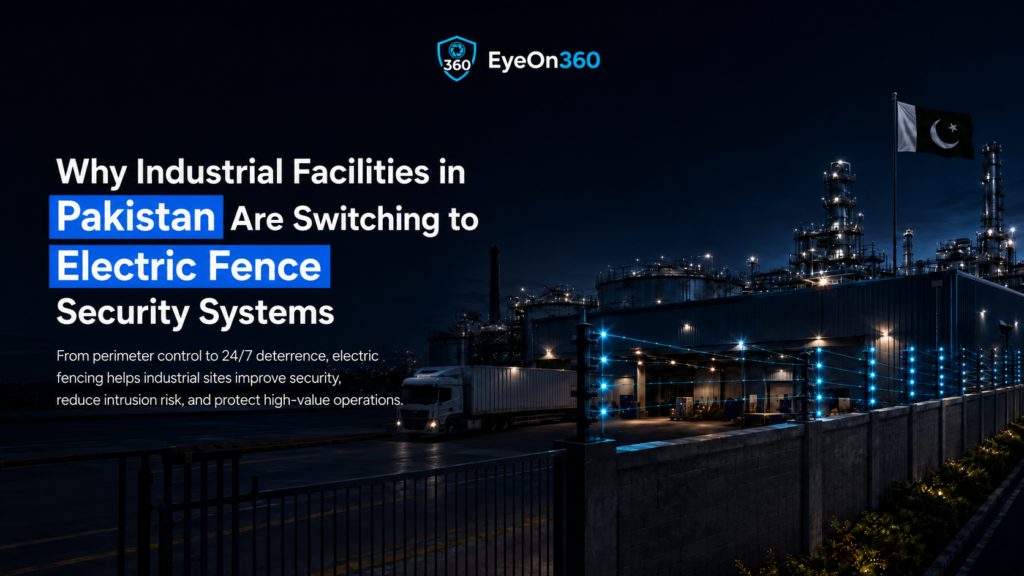
If you have visited any industrial estate in Pakistan these days, you will find a silent revolution going on — for example, the SITE area in Karachi, industrial estates of Lahore, and even large logistics yards near the highways. But warehouses and factories are no longer only using traditional boundary walls, guards, and basic surveillance setups. Rather, many are retrofitting industrial perimeter security with Electric Fence Security Systems.
This shift is not due to the failure of older practices. It’s happening because there’s been a change in the risk, scale and value of industrial assets. Robberies are better coordinated, facilities are bigger and losses from a single security breach may be substantial.
As a result, industrial operators are now looking for systems that don’t just record incidents — they actively prevent them. Electric fencing has become one of the most practical answers to that need, especially when integrated with modern surveillance and access control solutions offered by companies like EyeOn360.
Table of Contents
The real Electric Fence Security Systems challenge in industrial zones
The security challenges are very different at industrial sites than at homes. A warehouse isn’t a building — it’s a giant area containing stored goods, equipment, raw materials and even cash high-value stock waiting for shipment.
The real problem is not that someone is trying to breach the system, but that they are not being detected.
In lots of instances, the traditional boundary walls are simply too big to be monitored all of the time. Even if guards are placed at access points, there are blind spots on the perimeter. CCTV Systems can assist but again require someone to be actively looking at screens or to review footage after an incident.
This leaves a gap between detection and response — and that’s where a lot of losses occur.
Why electric fencing is becoming the first line of defense
The growing use of electric fence is a change in the purpose of the fence itself. The boundary is no longer a passive barrier, but an active security layer.
When fenced around a warehouse or factory, the fence will constantly check for contact or tampering attempts. As soon as someone attempts to climb or intervene in it, the system reacts immediately to the appearance of a controlled deterrent pulse. No harm is intended and action is to be ceased.
In terms of practice, it translates to no longer having to rely solely on the response time of people. The system responds at the location of intrusion.
In a large industrial area where losses can be incurred due to delay responses, this change is essential.
Theft prevention: stopping incidents before they start
Theft prevention is one of the most important issue in industrial operators in Pakistan. Items in warehouses are commonly easily movable items that have a hard time being tracked in real time. However, once an unauthorized entry occurs, there is the potential for huge loss even if it is not identified for some time.
One way in which electric fencing can help to reduce this is by providing a psychological and physical barrier. Most intrusions are not very well planned operations – they’re opportunistic. If a perimeter has definite signs of active protection, many attempts are deterred before they ever start.
Partly that is why adoption rates are rising – it is a prevention-first strategy. It isn’t merely about catching intruders, it’s about making it less likely to be attempted in the first place.
Unauthorized access control in large facilities
Unauthorized access is another major problem in the industrial setting. Not all cases of intrusion are external, sometimes it is the uncontrolled movement within or around the perimeter of the facility.
Especially large logistics yards, have several entry points for vehicles, employees and deliveries. This means that all of them need to be managed efficiently, and manual supervision is not enough.
A controlled outer layer is provided by electric fencing, clearly outlining secure boundaries. It can be used in conjunction with access control systems to ensure that access to sensitive areas is deliberate and under control.
This helps to avoid confusion, prevent unchecked access to the premises, and keep the security structure as clear as possible throughout the premises.
Integration with CCTV and monitoring systems
Electric fencing makes a good deterrent, and is most effective when used in an integrated system.
Electric fencing is frequently integrated into modern systems with CCTV cameras, alarm systems and monitoring dashboards. This enables the various components of the system to act in concert.
For instance, when the fence senses tamper, the CCTV cameras can automatically zoom in on the fence area. Meanwhile, alerts can be sent to security personnel or control rooms.
Rather than being discrete systems reacting independently, it’s a unified response system.
Security vendors such as EyeOn360 are working on this integrated approach in the industrial segment in Pakistan.
ROI comparison: electric fencing vs traditional security upgrades
When it comes to business, security isn’t just about protecting your data, it’s also about cost efficiency and value.
Typical physical security enhancements for an industrial facility typically involve:
- To increase the height of the wall and/or reinforcement.
- Installing more guards to patrol around the property
- Expanding CCTV coverage
- Maintaining and repairing physical barriers over time
These are all factors that help with security, but they also add to the recurring costs and are still largely reliant on human response.
However, electric fencing alters the situation because it has eliminated the need for manual labour and offers industrial perimeter security at all times.
Cost efficiency over time
In addition to the relatively low maintenance costs of electric fencing, once installed it avoids the costs of continuing to staff the fence. The difference is more marked over time for large warehouses and logistics yards.
Reduced loss risk
The greatest ROI is not only installation cost — it’s loss prevention. Any one large theft incident is enough to more than pay for the investment to prevent it.
Scalability
The great advantage of electric fencing is that it can be extended around large perimeters without a corresponding increase in the complexity of operation as the operation expands for industrial growth.
For those facility operators looking at a 3-5 year time frame, electric fencing can provide better cost to protection than traditional incremental security improvements.
Why industrial adoption is accelerating in Pakistan
There are a number of obvious motivations for such a transition at more industrial sites:
First, values and the amount of inventory now held have risen, making the risk exposure greater than it was previously.
Second, industrial areas are growing in size, making it more difficult to effectively maintain the traditional monitoring.
Thirdly, there is an increasing recognition that security is best achieved by taking a proactive, not reactive approach.
Electric fencing meets all three of these requirements – it is scaleable, it is active and it has a prevention focus.
The direction industrial security is moving toward
The future of industrial security in Pakistan is definitely towards the integrated and layered approach. CCTV, smart access control and real time systems are on top of electric fencing, which is now the foundation layer.
In the future, these systems will be expected to improve their intelligence, and remote monitoring and automated threat detection will become commonplace.
But the underlying concept is going to stay the same: Security is most effective if it helps stop things from happening.
Final thoughts
Traditional security is not being replaced in the industrial facilities in Pakistan, it is being upgraded. While boundaries, guards and cameras are still part of the equation, they are not the only ones for large scale operations.
Electric fencing has proven to be an effective solution due to the fact that it fills the primary industrial security hole – active response on the perimeter.
Together with CCTV and smart monitoring systems, it forms an integrated and robust defence system, that not only provides better protection but is also more efficient in terms of operation.
As industrial areas grow, this trend toward a unified approach to perimeter security is sure to grow in prevalence and not an exception.