
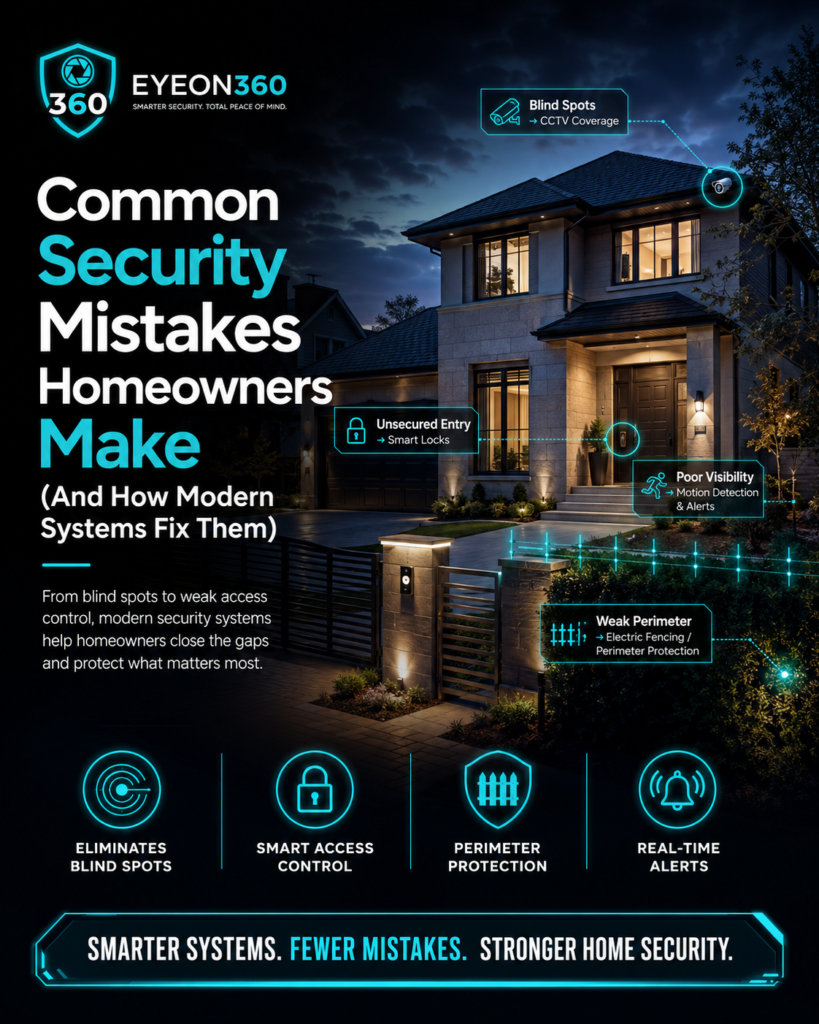
Most homeowners don’t consider security until it becomes an issue. Most people begin to look at how secure their home is when a break-in, theft attempt, or even a suspicious occurrence occurs. The surprising thing is that in many instances it was neither the lack of modern security solutions, but rather tiny oversights in the planning or implementation of security.
In urban areas such as Karachi, where residential areas are growing and the layout of properties are becoming increasingly complex, these errors are more prevalent. Fortunately, today’s security systems are engineered to address these vulnerabilities.
Let’s examine some of the most frequent errors made by homeowners, and how newer systems are addressing them.
Table of Contents
Weak or outdated locks that create easy entry points
The lack of good locking of doors and gates is one of the easiest to overlook security problems. Still many homes are using the basic mechanical type of locking which is subjected to wear and tear or is easily outsmarted.
Sometimes the issue is not apparent. Although the lock looks sturdy on the outside, it may not be as secure as it needs to be when it comes to forcing its way. There is also no monitoring in some cases of the number of times a gate is accessed or if anyone tried to gain unauthorized access.
This is all changing with modern solutions such as smart locks. Smart locks provide further security by incorporating controlled access features like PIN codes, mobile authorization, or biometric verification, thus complementing the physical strength of the lock. They also maintain a digital log of attempts, providing accountability and traceability.
This does not just mean access becomes physical, it’s monitored and controlled access.
Poor CCTV placement that leaves blind spots
Another very common error is the placement of the CCTV. It is common to see many homeowners install cameras in their homes after they already have them built, without considering appropriate coverage.
This means that cameras are frequently set to the point of the main gate or front door and not to side walls, back entrances or other less visible corners. They are the very areas where security dangers are greater.
Another point is that CCTV systems are generally seen as passive recording devices. They are placed to “record everything”, without being actively connected to other systems or monitored in real-time.
In modern security solutions, a combination of CCTV, motion detection and perimeter alerts overcome this. A camera can be a responsive tool when integrated well. When activity is identified from cameras near the boundary/fence line, the cameras can automatically switch focus and start to record a particular area as soon as they have detected the activity.
This can significantly decrease blind spots and increase response time.
Poor perimeter planning around the property
One of the biggest errors homeowners make is to not plan the perimeter. Security is commonly applied as a collection of individual components – gate here, camera there, wall everywhere, rather than as a whole.
The perimeter is, in fact, the first line of defense. When not designed correctly, all internal components are exposed.
Many houses use only boundary walls and don’t think to how easy it is to access these walls from the outside. Access may be facilitated by external features such as trees, buildings, or ground level that are not intended to be part of the design.
This is where electric fencing is becoming more of a corrective layer. It not only marks the boundary but also forms an active perimeter that reacts instantly when in contact or tampered by anyone attempting to cross it. It is also highly compatible with CCTV and alarm system as it provides a complete perimeter awareness system instead of a passive structure.
Companies like EyeOn360 are focusing on these integrated perimeter designs, where walls, fencing, and surveillance work together instead of separately.
Relying too much on a single security system
The first assumption that people make about home security is that they don’t need more than one system. Some use CCTV, others use guards, some use strong locks.
The problem with this is that all systems will have their own restrictions. CCTV can only see, entry points can only be locked and guards can only cover a small area at one time.
Thinking for security has shifted to layers of security. This implies the existence of systems with different roles:
- One of the challenges with perimeter deterrence is dealt with by electric fencing.
- Monitoring and verification is taken care of by CCTV.
- Controllable access is managed by smart locks.
If these systems operate in isolation, gaps will be there. Those gaps, however, are greatly diminished when they are linked together.
Ignoring real-time alerts and monitoring
One of the most frequent errors is buying a security system and not effectively utilizing it. There are many people who install CCTV and alarms but don’t have real time notification or monitoring system enabled.
This will be a situation of having security but lacking response. The essence of security is all about time. No incident can be controlled if the delay is even a few minutes.
Modern systems offer a solution by instantly notifying mobile, control room, or security via alerts. The system reacts swiftly when an unusual event occurs, such as at a gate, fence or access point.
This is one of the greatest advances in home security today from a passive recording to an active monitoring system.
Treating security as a one-time installation
Security is frequently regarded as “set and forget.” However, in the real world, situations evolve. The effectiveness of a system can be impacted by new construction, changes in neighborhood activity or simply wear and tear.
Many homeowners fail to review their security installation after it is put in place, resulting in inadequate coverage or less effective protection areas.
Today’s “integrated” systems are more flexible. Are customizable and adaptable. For instance, more CCTV cameras could be installed to fill in new blind spots, or electric fencing can be increased to provide greater perimeter security.
Security today is not a static system – it is a dynamic one.
How modern systems fix all these mistakes together
In light of all these factors – weak locks, non-seeing CCTV, inadequate perimeter design and poor integration – it is obvious that a solution is needed. If the problem is with single components, it’s not the problem.Lack of coordination is the problem, not individual components.
Modern security solutions overcome this by creating one security system.
Electric fencing is used to fence and detect trespass. The CCTV offers visual verification on the spot. Smart locks manage access, and there is a log of who accesses the lock. These systems combine into a comprehensive security solution, encompassing both prevention and detection, as well as response.
This is not a system that responds to events after they occur but is always active and attuned.
Final thoughts
The majority of issues with the home security solutions are not related to the absence of equipment, but to inadequate planning. Locks, cameras and systems that are not connected are weak points that are not always discovered until they are compromised.
Modern security is not only about modern devices, it’s also about a new way of thinking. Security is best when each layer reinforces the preceding one rather than standing alone.
With growing numbers of homeowners turning to integrated solutions, a combination of CCTV security, electric fencing, and smart access control is emerging as the preferred method for robust home security, especially in urban areas such as Karachi.