
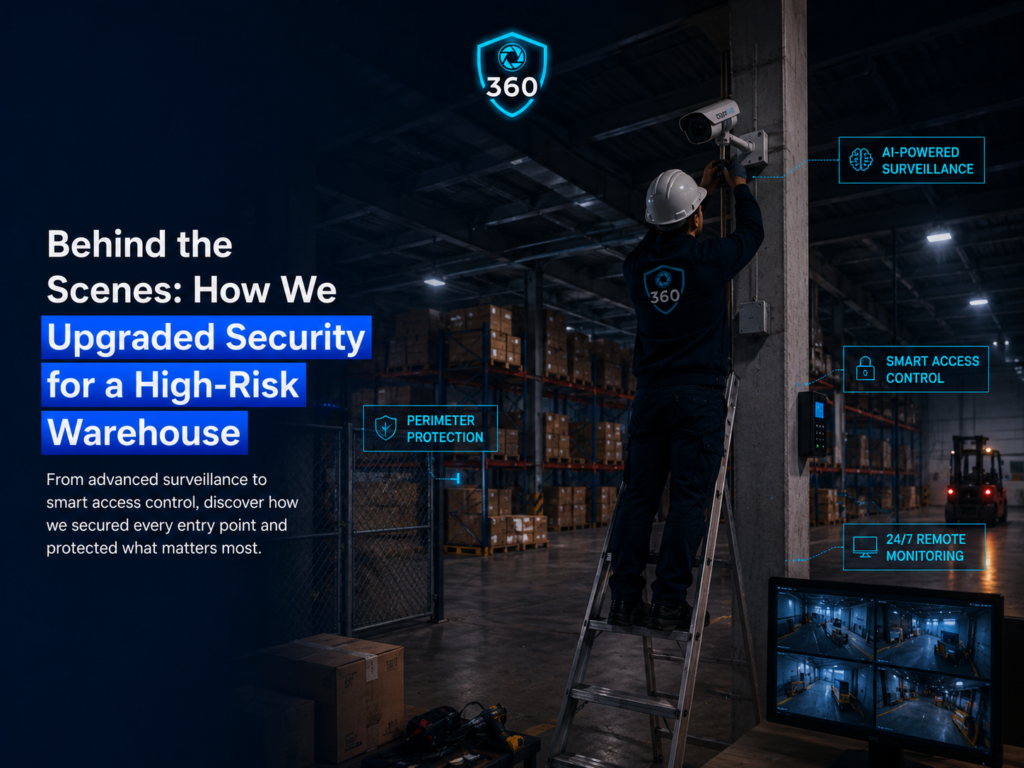
Warehouses face a different level of risk from homes and offices. Large boundaries, valuable stock, loading activity, night shifts and frequent movement of workers and vehicles create more opportunities for theft, damage and unauthorised access.
This behind-the-scenes walkthrough uses a representative high-risk warehouse scenario based on common Security System problems found in Karachi. It shows how a weak, disconnected setup can be turned into a more controlled system without relying on cameras alone.
Table of Contents
The Starting Point: Equipment Was Present, but Control Was Missing
The warehouse already had several cameras. On paper, it looked protected. In practice, the Security System team faced major weaknesses:
- Blind spots around loading bays and rear boundary walls
- Poor night visibility in open storage areas
- No clear record of who entered restricted zones
- Guards depending mainly on verbal instructions
- Footage stored in different places with no organised review process
This is a common problem. More devices do not automatically create better security. The real question is whether the system helps people notice, verify and respond to risk.
5 Risks Identified During the Site Review
A complete review focused on how theft or unauthorised movement could actually occur. The main risks were:
- Vehicles entering without consistent identity checks
- Workers moving between zones without visible permission levels
- Dark corners near the rear wall and generator area
- Camera views blocked when trucks parked at the loading bay
- No immediate escalation process for suspicious activity
The review also considered human behaviour. Guards changed shifts, supervisors used different rules, and temporary workers were not always easy to identify. These gaps mattered as much as the hardware.
Designing Coverage Around Movement, Not Just Walls
The upgraded design mapped people, stock and vehicles through the site. Cameras were positioned to capture faces at entrances, number plates at vehicle points and activity around high-value storage zones.
Instead of placing every camera high and wide, selected cameras were installed at practical identification angles. Overlapping views reduced blind spots, while lighting adjustments improved night footage.
The project used commercial security solutions that connected surveillance with access procedures, guard responsibilities and incident reporting.
The Human Element: Clear Rules Reduced Confusion
Technology cannot decide who should be trusted. People still make that decision, so the warehouse needed simple rules that every shift could follow.
- Visitors were logged and escorted beyond reception
- Temporary staff received time-limited access
- Drivers remained within approved loading areas
- Guards used a written escalation process for alarms
- Supervisors reviewed incidents instead of relying on memory
These steps reduced informal exceptions. When rules are clear, staff are less likely to wave someone through simply because that person appears familiar.
4 Improvements That Made Monitoring More Useful
- Centralised viewing for key indoor and outdoor cameras
- Alerts for movement in selected areas after working hours
- Better recording retention and easier footage retrieval
- Remote access for authorised managers during critical events
Well-planned remote monitoring solutions gave managers visibility without replacing the onsite team. Remote access supported verification, while guards remained responsible for physical response.
Testing the System Before Handover
A security upgrade is not complete when the cameras switch on. The system was tested during daytime, after dark, during vehicle movement and under simulated internet or power interruption.
The team checked whether faces could be identified, whether alerts reached the right people, and whether guards understood what action to take. Weak angles and confusing notifications were corrected before the setup was considered ready.
What Changed After the Upgrade
The biggest improvement was not simply clearer video. The warehouse gained a more consistent way to control access, monitor sensitive areas and respond to unusual activity.
EyeOn360 focuses on the connection between risk, technology and human action. A warehouse becomes safer when every device has a purpose and every person understands their role.
Quick Checklist for Warehouse Managers
- Can vehicle plates and driver faces be identified?
- Are loading bays visible when trucks are parked?
- Are restricted zones controlled and recorded?
- Do guards follow one written response procedure?
- Can managers retrieve relevant footage quickly?
Pro Tip
Review security from the viewpoint of someone trying to exploit the site. Follow the path from the outer boundary to the most valuable stock and note every point where identity, movement or response depends on assumption. Those assumptions are usually where the highest risks remain.