
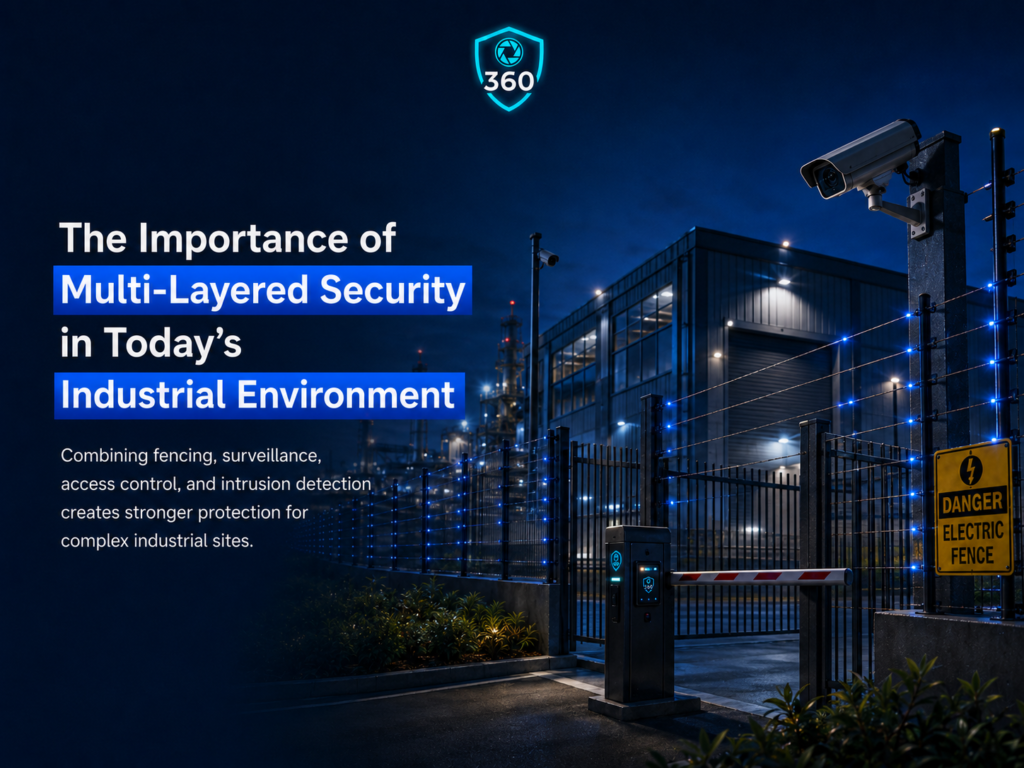
One barrier is no longer enough
Industrial sites do not face one simple risk. They face trespassing, theft, vandalism, internal movement issues, loading gate pressure, vehicle access problems, blind spots, and after hours intrusion. A single gate, camera, or guard post cannot cover all of that. Multi layered security works because it accepts a basic truth: every layer can miss something, but layers working together make failure less likely. A wall slows movement, a fence detects contact, a camera records activity, an alarm draws attention, and a trained response team decides what to do next. That chain is far stronger than depending on one protective measure.
Table of Contents
The main layers industrial sites need
A practical security plan usually starts with the outside edge and moves inward. Each layer should support the next one, not sit separately like unused equipment.
- Physical barriers control where people and vehicles can enter.
- Detection systems alert the team when someone touches, crosses, or approaches a restricted area.
- Cameras help verify what is happening before guards move toward a risk.
- Access rules limit who can enter sensitive zones, storage rooms, and control areas.
For modern Industrial security systems, the value comes from connection. A camera without an alert may record a problem too late. A fence without response may only make noise. A guard without visibility may arrive without context.
Why industrial environments are harder to protect
Factories, warehouses, fuel sites, plants, and logistics yards are rarely quiet, simple places. Trucks enter and leave. Contractors arrive for short jobs. Valuable equipment may sit outdoors. Some areas are bright while others stay dark. Shift changes create movement, and emergency exits cannot simply be locked to solve the problem. This is why EyeOn360 treats industrial protection as a layered design challenge. The system has to work around real operations, not against them. Security that blocks normal work will eventually be bypassed by the people it is meant to protect.
Outer security buys time
The outer boundary is important because it gives the site time. If a trespasser reaches a storage area before anyone knows, the response is already late. A boundary with fencing, lighting, warning signs, sensors, and cameras can slow the person down and create an early alert. That early alert matters. It gives guards time to check video, move to the right gate, call support, or lock down a nearby zone. Multi layered security is not only about stopping someone at the first line. It is about making sure the site is not surprised.
Where monitoring fits into the plan
Monitoring is the layer that turns equipment into usable information. Without it, even good hardware can become passive.
- Live alerts help teams focus on active risks instead of watching every camera constantly.
- Recorded footage supports investigation after theft, damage, or safety incidents.
- Remote viewing can help managers check activity without being on site.
- Regular maintenance keeps cameras, alarms, and sensors from becoming decorative tools.
This is why 24/7 surveillance solutions are often discussed with layered protection. Constant visibility does not mean someone stares at screens all day. It means the site has a dependable way to capture, review, and respond to important activity.
Access control protects the inside
Many losses do not begin at the outer wall. They happen when people move too freely inside the property. A visitor enters the wrong area. A contractor walks near storage. A staff member uses an old key. Access control reduces that confusion by limiting movement according to role, time, and risk. It also creates accountability. When a door, gate, or restricted zone has a clear access record, management can understand who entered and when. EyeOn360 often combines this inside layer with cameras and alarms so the site has both control and evidence.
Layering also supports daily management
The benefit is not limited to crime prevention. Layered systems make daily control easier. Supervisors can check whether a delivery entered through the right gate, whether a contractor stayed inside the approved zone, or whether a late night alarm came from a person, animal, vehicle, or loose object. That detail reduces panic. It also helps management speak with guards using facts instead of blame.
Over time, the site becomes easier to run because security information is organized, visible, and tied to real action. It also helps during audits and insurance reviews. A site that can show access records, video evidence, alarm logs, and maintenance history looks more controlled than a site that only says guards were present. That documentation can guide better decisions after an incident. Managers can see whether the weak point was a gate, a camera angle, a response delay, or a forgotten internal door. Then improvements become specific rather than random purchases made after stress. That is where layered planning becomes a daily management tool, not only a security expense after something goes wrong again.
Mistakes to avoid when building layers
Layered security can still fail if it is planned badly. More equipment is not always better. The layers must be useful, maintained, and easy for staff to understand.
- Do not install cameras where lighting makes footage unclear at night.
- Do not place alarms without a clear response procedure.
- Do not ignore service gates, rear walls, roof access, or utility openings.
- Do not let old passwords, unused access cards, or broken sensors remain active.
A layered plan should feel organized. Each part should answer a simple question: what does this layer prevent, detect, verify, or help the team do?
Conclusion
Multi layered security is important because industrial risk comes from many directions. No single tool can handle every gate, wall, worker, vehicle, visitor, and dark corner. A stronger plan combines barriers, detection, surveillance, access control, lighting, maintenance, and response. When these parts work together, the site becomes harder to enter, harder to exploit, and easier to manage. That is the real value of layered security: it reduces guesswork and gives teams more time, better information, and clearer control.